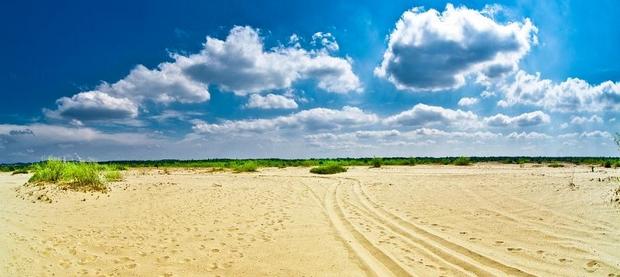
Błędów Desert – Sahara in central Poland
The desert in Poland is the most famous in the world
50 kilometers from the city of Krakow is a desert called the “Polish Sahara”
Desert formations are not typical for Poland, but sandy soils are quite characteristic. The desert near Krakow was formed under the influence of anthropogenic factors – back in the 13th century, people cut down all the trees here and started the process of desertification. Today it is 33 square kilometers of sand. It is the second largest desert in Europe after the Ukrainian Aloshkiv Sands.
Observation platforms are arranged on hills – the Chubatka hills (382 meters) and Dombrowka (355 meters).
It is good to take off from Chubatka by paragliding. You can also see the ruins of a command post of German troops from World War II here.
From Dombrowka, the desert landscape is more noticeable, here you can also see the remains of a bunker – a command post of Polish troops from World War II.
You can also look at the desert by descending from the hills; several hiking and horseback riding routes pass through it. In addition, several special tourist trails have been organized on the territory of the desert. These are routes laid in such a way that visitors pass as many of the sights of this place as possible along the way. The northernmost part of the desert is occupied by a military training ground, and access there is prohibited.
See also: Russia is operating in Europe using sabotage methods
Błędowska Desert – “Polish Sahara” near Krakow
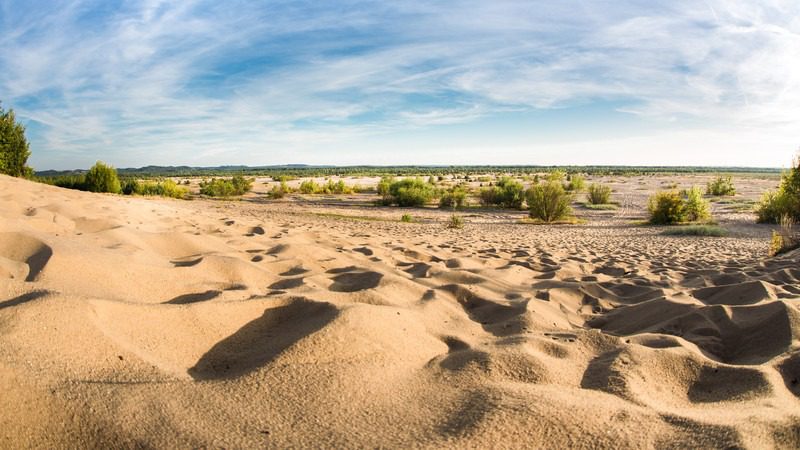
Just 50 kilometers from Krakow is one of the most unusual natural phenomena in Poland – the Błędowska Desert (Pustynia Błędowska), which is often called the “Polish Sahara”. This is a unique natural phenomenon that attracts both tourists and scientists, thanks to its unusual history and impressive landscapes.
Origin of the desert
Despite the fact that deserts are not typical of Poland as a natural zone, the Blendowska Desert was formed as a result of both natural and anthropogenic factors.
During the last glaciation, thick sand deposits were formed here – up to 40 meters deep. However, desertification itself began in the 13th century, when intensive deforestation for the needs of the mining industry and metallurgy caused the soil to lose its natural cover. The wind began to actively carry sand, and later dunes, sand dunes and open spaces resembling a real desert appeared here.
In the 20th century, the territory was partially overgrown, but in 2013 a large ecological project was launched to restore the desert landscape: self-sowing trees and shrubs were removed, the sands were cleared and the natural appearance was restored.
Today, the desert area is about 33 square kilometers, making it the second largest desert in Europe after the Aloshkiv Sands in Ukraine.
What to see
The Blendovska Desert is not only a natural phenomenon, but also an area of active tourism and history.
Observation points:
- Chubatka Hill (382 m)
– An excellent point for watching sunsets, launching paragliders and photo hunting.
– Here are the ruins of a German command post from the Second World War.
– Dąbrówka Hill (355 m)
– From here you can enjoy the most impressive view of the desert as an open sea of sand.
– There are also the remains of a Polish military bunker.
In 1965, scenes from the historical film “Pharaoh” directed by Jerzy Kawalerowicz, based on the novel by Bolesław Prus, were filmed here. The Blandów Desert played the role of the Egyptian Sahara!
Tourist trails with signs and navigation pass through the desert.
See also: Ukraine: Economy: Western Support Declines, Risks Grow
The most popular routes:
- Walking trails – from 3 to 10 km, laid through the most picturesque areas.
- Horseback riding – organized by local stables and farms.
- Cycling routes – with the possibility of renting bicycles.
- Guided tours – both historical and nature.
- Military quests – interactive walks with elements of World War II reconstruction.
Important: the northern part of the desert is occupied by a NATO military training ground, the entrance to which is completely closed to tourists.
Tourist reviews
- Anna, Warsaw:
“I never thought that in Poland you could feel like you were in the Sahara. The views are mesmerizing, especially at sunset. Be sure to take water and a hat!” - Thomas, Cologne:
“We came by bike – wonderful routes and very friendly locals. The hills with military ruins were especially impressive.” - Maria, Kyiv:
“We shot a photo shoot here – the landscapes are simply unreal. It’s almost hard to believe that this is Poland.”
Prices and information for tourists
Entrance to the territory is free.
- Guided tours: from 40 to 70 PLN (~10–16 EUR).
- Horseback riding: from 80 PLN (~18 EUR) for 30 minutes.
- Parking: 10–15 PLN, depending on the point.
- Bike rental: from 25 PLN for 2 hours.
See also: European Attitudes Toward Ukrainian Refugees
How to get to the Blidnoska Desert
- By car: From Krakow – about 50 km. On the road No. 94 (Kraków-Olkusz), then follow the signs to Klucze or Chechło.
- By public transport: By bus from Krakow to Olkusz, then change to a local bus to Klucze.
- By train to the Jaroszowiec Olkuski station, and from there – on foot by taxi (about 5 km to the desert).
Best starting points:
– Klucze (from the north)
– Chechlo (from the south)
– Błędów (from the east)
IMPORTANT: In summer the sand gets very hot – wear closed shoes that will protect you from the hot sand (70+ degrees).
- It is recommended to visit in spring or autumn – comfortable weather and fewer people.
- Excellent place for aerial photography and stargazing – the sky is very dark here.